Synaptix™ Platform Overview: The AI Infrastructure Operating Platform
How Synaptix™ brings private-cloud infrastructure, service delivery, operational context, and governed AI into one operating environment—and how to evaluate it against your own operating priorities.
Connect Infrastructure to Better Operating Decisions
Synaptix™ brings private-cloud infrastructure, service delivery, operational context, and governed AI into one operating environment. It helps enterprise and service-provider teams understand their infrastructure, investigate issues, deliver services, and carry out supported actions with control.
Whether the starting point is VMware modernization, private-cloud service delivery, or operational efficiency, the objective is the same: give teams a more connected way to run infrastructure and improve the services it supports.
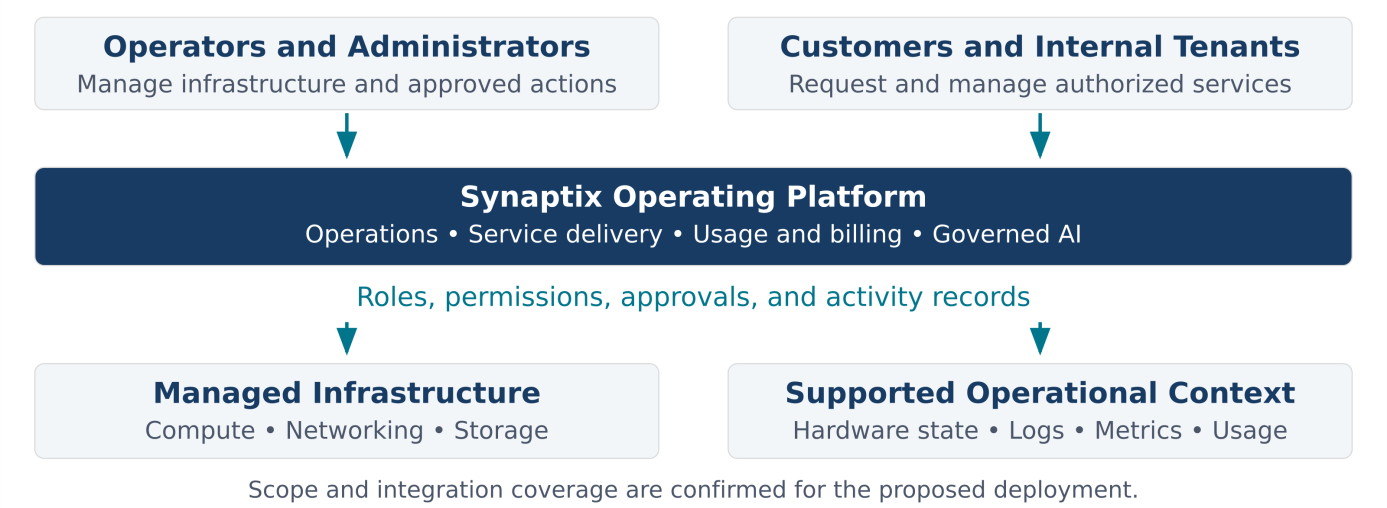
Synaptix™ connects authorized users with managed infrastructure and supported operational data. The diagram shows logical relationships, not a physical deployment design.
The Business Value of Connected Operations
Give infrastructure teams the context and control to work more effectively.
Infrastructure teams often coordinate work across separate systems for virtualization, networking, storage, monitoring, security, customer services, and billing. Every handoff can require someone to reconstruct what is happening, who is affected, and what can safely change.
Synaptix™ connects those operating concerns around the infrastructure it manages. Teams can work with infrastructure state, tenant and service context, operational signals, and authorized workflows in one environment. The commercial opportunity is to reduce coordination effort while improving service consistency and accountability.
Customer Priority
How Synaptix™ Contributes
What to Measure
Improve operator productivity
Bring relevant infrastructure and service context into investigation and supported workflows.
Investigation time, manual steps, handoffs, and rework.
Deliver services consistently
Use offerings, quotas, roles, portals, and VM lifecycle functions to organize service delivery.
Request-to-provision time and provisioning success rate.
Understand service economics
Connect resource usage, metering, tenant visibility, and billing workflows.
Usage reconciliation effort, billing accuracy, and allocation visibility.
Control infrastructure changes
Apply permissions, human approval, and activity records to supported AI-assisted actions.
Approval traceability, change outcomes, and evidence completeness.
Different Starting Points with a Shared Operating Goal
Enterprise teams can focus on internal cloud services, application support, and accountable resource use. Service providers can focus on tenant operations, service offerings, usage, and billing. Data-center operators delivering infrastructure services can assess how the platform fits their compute, storage, network, and customer-service responsibilities.
Benefits should be demonstrated against the customer’s baseline. A pilot establishes which workflows improve, how much effort changes, and what the operating team can reliably support. Productivity gains can release capacity for other work; they do not automatically become cash savings.
One Platform for Infrastructure and Services
Connect day-to-day infrastructure work with the services customers consume.
Synaptix™ combines VM-based private-cloud operations with multi-tenant service delivery, usage visibility, governance, APIs, and AI-assisted workflows. Its foundation brings compute, networking, and storage into a common operating environment.
Platform Capability
What Teams Can Do
Customer Value
Compute Operations
Provision and manage VMs, templates, snapshots, placement, high availability, and live migration within supported designs.
A consistent environment for VM lifecycle and service operation.
Align connectivity and segmentation with tenants and workload needs.
Storage
Manage Ceph-integrated storage, volumes, and snapshots; qualify protection integrations for the design.
Connect storage lifecycle and capacity to the services that depend on them.
Service Delivery
Organize accounts, projects, roles, offerings, quotas, and customer or internal-tenant portals.
Make authorized services easier to request, deliver, and manage.
Usage & Billing
Bring metering, usage visibility, invoices, and tenant billing workflows into the operating model.
Improve accountability for resource consumption and service charges.
Observation & AI
Use health, logs, metrics, events, and available infrastructure context for investigation and supported AI workflows.
Reduce the effort required to assemble context and assess next steps.
Integration & Control
Use APIs, access controls, activity records, and qualified automation integrations.
Connect the platform to established processes and keep actions accountable.
Fit the Platform to the Service You Operate
An internal cloud may emphasize approved offerings, cost allocation, and application-owner experience. A provider may emphasize tenant separation, service consumption, and billing. The platform connects these concerns without requiring every customer to adopt the same commercial model.
Exact network patterns, guest configurations, backup and recovery workflows, and third-party integrations are confirmed during architecture review. Availability is assessed for the proposed release and deployment; a general capability does not establish every product combination.
Continuous Context for AI Assisted Operations
Monitoring supplies the operating picture; AI helps teams investigate and act.
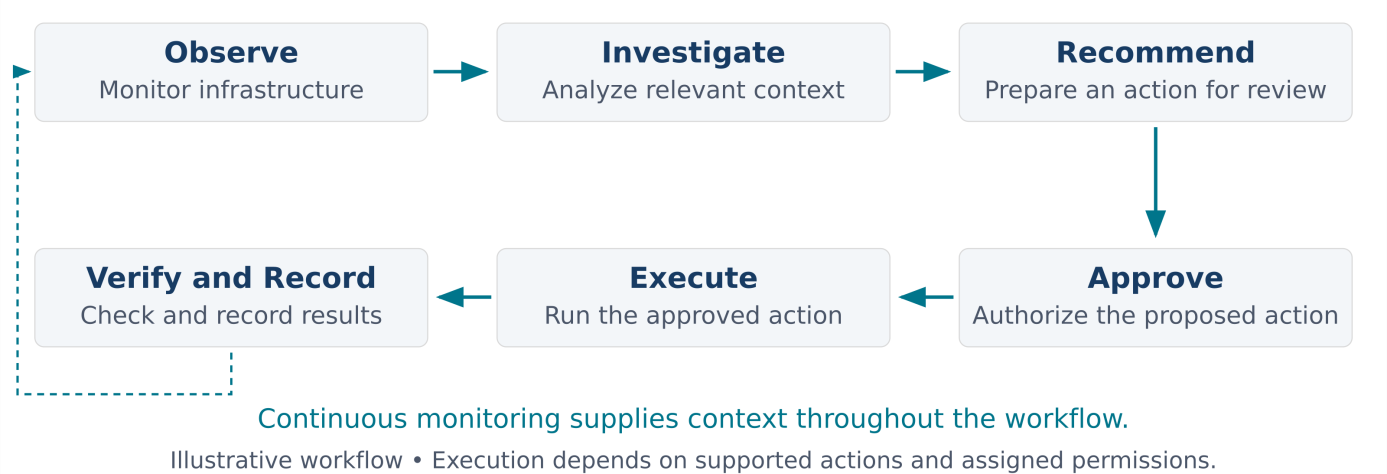
Synaptix™ continuously monitors the infrastructure it manages, including when AI Chat is not in use. Its operating context brings together supported hardware-management information, host resources, logs, metrics, events, and usage data. That context gives operators a connected starting point for understanding conditions and their service implications.
AI interaction lets authorized users ask infrastructure questions, examine available signals, assess recommendations, and review supported actions. Local or deployment-appropriate language models operate within the data and permission boundaries of the agreed design.
A supported action moves through human review and authorization before execution. Verification closes the workflow and records what happened.
An Illustrative Investigation
An operator investigating a slow service needs to understand more than a single alert. The relevant picture may include guest demand, host pressure, storage behavior, network conditions, and other affected workloads. Synaptix™ helps assemble the available context and supports analysis of likely causes.
If a supported action is appropriate, the operator reviews its scope and expected effect before approval. The workflow then checks the result and records the activity. The exact signals, analysis, and executable actions depend on the integrations and workflows validated for the deployment.
Measure the Work that Changes
A useful demonstration shows how long it takes to understand an issue, how many interfaces and manual steps are involved, and whether the operator can explain and verify the proposed action. Better operator decisions and repeatable workflows are the practical test of the AI experience.
Governance Built into the Operating Workflow
Keep authority, data access, and responsibility explicit.
Infrastructure actions can affect availability, customer services, and data. Synaptix™ connects AI assistance with role-based access, tenant boundaries, human approval, and activity records so that supported actions remain accountable to authorized people.
Permissions Follow the User & the Action
Operators and administrators work within assigned roles. Customers and internal tenants use the services and resources available to them. AI-assisted workflows must respect those boundaries: the ability to ask a question does not itself authorize a change.
Approval is Part of Execution
For supported AI-assisted actions, an authorized person reviews the proposed change before execution. The operating process should make the affected resources, permitted action, expected result, and required approval clear. Teams retain responsibility for change windows, recovery arrangements, and service acceptance.
Activity Records Support Review
Records of recommendations, approvals, actions, and results help teams review how a workflow was carried out. During evaluation, confirm which events are captured, who can access them, how they are retained, and how they connect to existing incident or change processes.
Data Handling Follows the Deployment Design
Synaptix™ can be deployed with local operational context and local language models. The architecture review establishes where models run, where data is stored and processed, what any external integration receives, and how access and retention are controlled. Local deployment alone does not establish regulatory compliance.
Control Area
Customer Design Decision
Identity & Tenancy
Roles, tenant boundaries, administrative access, and identity integrations.
AI & Infrastructure Actions
Permitted workflows, approval owners, and escalation or recovery procedures.
Data & Records
Processing locations, external transfers, access, retention, and audit requirements.
Security & Assurance
Required controls, evidence, testing, and any applicable certification obligations.
Security and compliance requirements are evaluated against the actual deployment and its evidence. Product controls contribute to that assessment; they do not replace it.
Architecture & Deployment
Understand the managed environment and the boundaries around it.
Synaptix™ combines its operating experience and AI workflows with a private-cloud foundation. It brings together physical and virtual infrastructure context, service delivery, usage, and supported control interfaces.
The platform is software for customer or partner operation under an agreed deployment model. Architecture review establishes the infrastructure it manages, integrations it uses, data it can see, actions it can perform, and responsibilities retained by each organization.
Logical Layer
Role in the Operating Environment
Operator & Tenant Experience
Administrative tools, customer or internal-tenant services, and AI interaction.
AI Context & Workflows
Relevant infrastructure signals, analysis, recommendations, approvals, and action records.
Platform Services
Infrastructure management, service delivery, governance, usage, billing, and APIs.
Adopt Around a Defined Operating Scope
A VMware replacement program evaluates Synaptix™ as a destination for qualified workloads. An organization exploring operational improvements alongside an existing environment first establishes integration coverage, ownership, and the specific workflows that can be supported. These are distinct adoption designs, even when they pursue similar operating outcomes.
Running alongside an environment does not imply universal control of its hypervisor or third-party tools.
Keep Operating Responsibilities Clear
Define hardware ownership, platform administration, backup and recovery, monitoring, incident response, maintenance, and escalation before production. MoirAI’s product and support scope, partner delivery work, and customer responsibilities should be documented separately. Agree support coverage and operating responsibilities as part of the deployment.
Use the architecture review to resolve redundancy, failure domains, capacity, network design, data handling, and integration details. A successful deployment is a supported operating design, not simply a completed installation.
VMware Modernization with Synaptix™
Use the platform transition to improve how infrastructure is operated.
Synaptix™ provides a VMware replacement path for workloads that meet the destination’s compatibility and operating requirements. Its value also includes service delivery, usage visibility, governance, APIs, and AI-assisted operations around the new environment.
The modernization decision should therefore examine both workload fit and the way the team wants to operate afterward. A successful migration preserves required service behavior while creating a practical opportunity to simplify provisioning, investigation, resource accountability, and supported change workflows.
Plan the Destination & the Operating Model Together
Assess the estate. Identify application owners, dependencies, guest requirements, availability needs, protection arrangements, and the workflows tied to the current platform.
Design the target. Confirm compute, network, storage, service offerings, access, integrations, and support responsibilities. Establish the economics of transition and parallel operation.
Prove representative workloads and workflows. Test migration methods, application behavior, data consistency, performance, recovery, and the operating tasks that matter to the team.
Move in controlled waves. Approve production readiness, release each wave, verify services, and establish operational ownership before retiring source resources.
Define the Improvement Beyond the Move
Workstream
Outcome to Demonstrate
Workload transition
Applications operate correctly and meet agreed performance and recovery criteria.
Service delivery
A representative service can be requested, provisioned, and governed consistently.
Operations
Teams can investigate conditions and carry out selected supported workflows with less coordination.
Economics
Usage and transition costs are visible; benefits are measured against a documented baseline.
Use the Companion Guides
The Executive Guide to VMware Modernization helps leaders define the desired outcomes and evaluation approach. The VMware Migration Playbook turns those decisions into discovery, pilots, migration waves, recovery plans, and acceptance records. This overview explains where Synaptix™ fits in that journey.
VMware modernization is one entry point. Organizations can also evaluate Synaptix™ around private-cloud service delivery or operational efficiency without a VMware replacement deadline.
Synaptik™ Cell and the Efficiency Opportunity
Connect better operations today with a path to greater useful compute capacity.
Synaptix™ is the infrastructure operating platform. Synaptik™ Cell is MoirAI’s proprietary compute technology, developed to reduce virtualization overhead and increase the useful workload capacity available from physical infrastructure. The platform and the compute technology play distinct, complementary roles.
Built Technology with Direct Measurements
Synaptik™ Cell is built and running in MoirAI’s architecture, with direct measurements from its lab and Tampa data-center environment. Testing has demonstrated lower memory overhead and efficiency potential for the configurations measured. This is a foundation for workload qualification and integration, rather than a uniform capacity promise for every application.
Potential business effects include supporting more qualified workloads on existing servers, reducing the server count required for a defined workload set, and deferring some capacity expansion. Actual outcomes depend on workload behavior, resource demand, isolation requirements, failure domains, and the production design.
Evidence or Status
What It Establishes
Direct engineering measurements
Observed behavior in the tested configurations. These results are distinct from independent third-party validation.
Modeled infrastructure scenarios
Potential fleet effects using stated workload and capacity assumptions. These are projections, not measured customer savings.
Integration and customer qualification
Work to establish supported configurations, migration effort, application behavior, isolation, performance, recovery, and production readiness.
Current Capabilities & Product Direction
Synaptix™ today supports VM-based private-cloud operations, multi-tenant services, governance, usage visibility, and supported AI-assisted workflows. Synaptik™ Cell extends the efficiency opportunity as integration and workload qualification progress; it is not a prerequisite for evaluating the current platform.
Broader product direction includes multi-site operational context, expanded observability, more policy-aware workflows, and increasingly coordinated operations. Those capabilities should be assessed by release and supported scope as they become available.
Evaluate the Complete Operating Result
A Cell evaluation should compare the same useful work under agreed service and resilience requirements. Measure capacity, performance, power where relevant, and operating effort together. A favorable overhead measurement is valuable evidence, but it is only one part of the customer’s production business case.
Evaluate Synaptix™ Against Your Operating Priorities
Begin with a focused use case and a measurable definition of success.
An effective evaluation starts with the work the customer needs to improve. Select representative infrastructure, services, and operators; agree the proposed deployment and support boundaries; then test the platform against a documented baseline.
Stage
What the Team Establishes
Discover
Operating priorities, current environment, service requirements, owners, and measurable pain points.
Design
Architecture, integration coverage, data boundaries, responsibilities, and a bounded evaluation scope.
Pilot
Representative workloads and workflows, acceptance criteria, test evidence, and issues requiring resolution.
Approve readiness
Required tests pass; risks, recovery, access, support, and operating ownership are accepted before production.
Operate and improve
Controlled production use, observed results, and expansion only after the next scope is reviewed.
Choose a Small Set of Meaningful Measures
Provisioning: time from an authorized request to a usable service, including manual steps and rework.
Investigation: time to assemble relevant context, understand a condition, and identify a supported next action.
Governance: whether permissions, approvals, action records, and result checks meet the agreed process.
Service economics: accuracy and effort in metering, usage attribution, and billing or internal allocation.
Workload readiness: application behavior, performance, recovery, and operating acceptance where migration is in scope.
Start with an Architecture & Workflow Review
Bring a concise description of the environment, the services you deliver, two or three workflows you want to improve, and the people accountable for them. MoirAI and your team can then define the deployment scope, demonstration, and evidence needed for a useful evaluation.
For VMware modernization, use the executive guide and migration playbook to carry the evaluation into a controlled transition. For Synaptik™ Cell, establish a separate workload and efficiency validation plan.