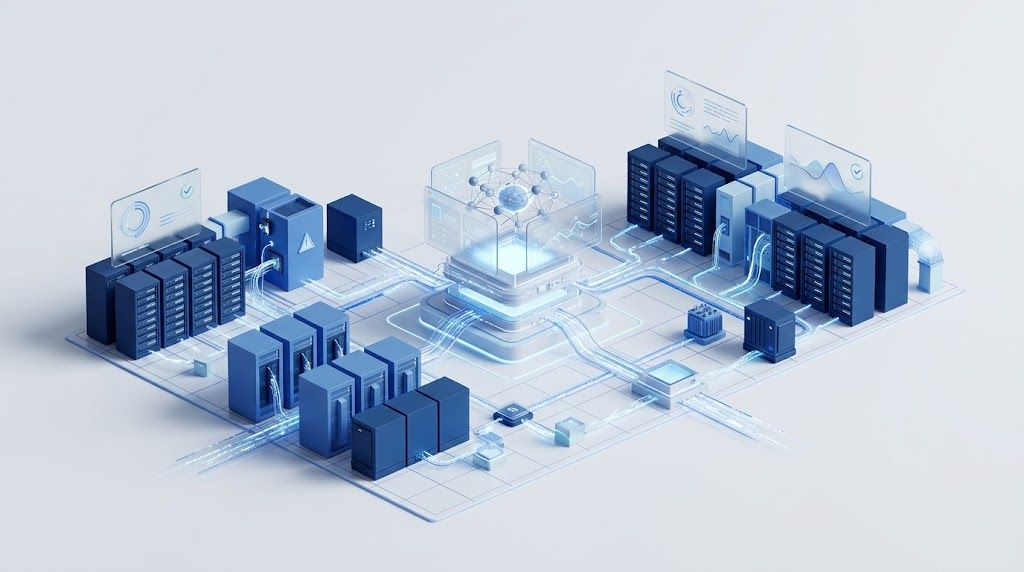
Data centers are drowning in operational complexity. Modern facilities generate terabytes of telemetry every day—temperature sensors, power feeds, server metrics, network flows, security events—but most organizations are still reacting to problems after they occur. A cooling unit fails. A rack overheats. A power surge cascades. Meanwhile, human operators are context-switching between dashboards, correlating disparate alerts, and trying to make sense of fragmented visibility across compute, storage, networking, and physical infrastructure.
This is exactly where data center AI operations changes the game. Instead of viewing infrastructure as a static topology to be monitored, forward-thinking data center operators are embedding artificial intelligence directly into their operational workflows—turning passive observation into active, predictive, and autonomous decision-making. The result: higher uptime, lower energy costs, faster incident resolution, and infrastructure teams that spend less time firefighting and more time delivering strategic value.
The Operational Reality: Why Data Centers Need AI
The traditional data center operating model was built for smaller, less complex environments. An operator could walk the floor, visually inspect racks, understand the relationship between workloads and cooling demands, and manually tune power distribution. That model is fundamentally broken for modern scale.
Consider the data:
- Scale complexity: Large colocation and cloud operators manage hundreds of thousands of servers, petabytes of storage, and thousands of tenant workloads across multiple geographic locations.
- Interconnection: Every system feeds every other system. Power distribution affects cooling efficiency. Cooling patterns affect network latency. Tenant placement affects both. Traditional tools treat each system in isolation.
- Real-time sensitivity: AI workloads—especially GPU-dense infrastructure—introduce power densities and thermal dynamics that demand sub-second observability and decision-making.
- Human bottleneck: Even with large operations teams, humans cannot process the volume and speed of signals required to optimize modern infrastructure. A single data center generates more data in an hour than a human team can analyze in a week.
The cost of this operational gap is substantial: unplanned downtime, inefficient resource utilization, over-provisioned power and cooling capacity, stranded resources, security blind spots, and regulatory compliance work that could be automated.
What Is Data Center AI Operations?
Data center AI operations refers to the integration of machine learning, large language models, and intelligent automation into infrastructure management workflows. It goes beyond traditional monitoring and alerting to enable three core capabilities:
1. Predictive Anomaly Detection
AI models ingest continuous telemetry across the entire infrastructure stack—power consumption patterns, thermal signatures, network flows, event logs—to identify anomalies before they cause outages. Rather than waiting for a temperature alarm at 95°F, predictive models flag unusual cooling behavior at 88°F and recommend corrective actions. Hyperscalers like Google and AWS have reported 20–40% reductions in thermal-related incidents using AI-driven cooling optimization.
2. Governed Autonomous Actions
Instead of generating alerts that require human investigation, AI agents can autonomously execute remediation steps—within human-defined governance policies. A cooling system trending toward inefficiency? AI can adjust fan speeds, recommend workload migration, or alert the facilities team with a specific recommended action, all without human intervention. The key: human operators define the boundaries of autonomy (SLAs, risk tolerance, cost thresholds) before the system runs.
3. Intelligent Resource Orchestration
AI optimizes workload placement, power allocation, and thermal dynamics as an integrated problem. Rather than treating compute scheduling, power management, and cooling as separate optimization targets, AI systems understand the relationships between them and make placement decisions that maximize efficiency across all dimensions. Facilities that achieve this level of integration report 15–25% reductions in power consumption per unit of work.
How Data Center AI Operations Works in Practice
Modern implementations follow a layered architecture:
Layer 1: Unified Observability
First, you need real-time data from all infrastructure layers: compute (CPU, GPU, memory), storage (IOPS, throughput, latency), networking (bandwidth, latency, packet loss), physical plant (temperature, humidity, power), security (threat detection, compliance logs), and business context (tenant SLAs, cost attribution, workload priority).
Leading platforms use a data lake or time-series database to normalize and correlate signals across these layers, making the data available via APIs and natural-language interfaces. NVIDIA's LLo11yPop framework, for example, layers LLMs on top of Elasticsearch observability data to enable operators to ask natural-language questions: "Why is GPU utilization low in cluster 7?" and receive a synthesized, root-cause explanation.
Layer 2: Predictive Models
Next, you train machine learning models to identify patterns that precede failures or inefficiencies. This includes thermal modeling (predicting hotspots before they happen), power demand forecasting (avoiding capacity constraints), workload behavior (identifying noisy neighbors or runaway processes), and security anomalies.
These models are typically hybrid: physics-based models for systems where the underlying dynamics are well-understood (thermal and power), and data-driven models for systems where behavior is emergent or complex (workload placement, network flows).
Layer 3: Agentic Workflows
The most sophisticated implementations add agentic AI—multi-step reasoning systems that can plan, execute, and iterate. An agentic workflow might work like this:
- Observe: Detect that power density in rack 47 is trending upward and will exceed safe limits in 2 hours.
- Orient: Query the observability system to understand current workloads in the rack, their SLAs, and available capacity in other locations.
- Decide: Recommend migrating a low-priority, non-interactive workload to a cooler rack, with estimated impact on that workload's SLA and power savings.
- Act: If approved by an operator (or automatically if policies permit), execute the migration, monitor the outcome, and report back.
This closed-loop decision-making is fundamentally different from traditional alerting. It moves the system from "tell me what's wrong" to "here's what I recommend and why."
Layer 4: Human Governance
Critical to ethical and safe AI operations is explicit human governance. Operators define:
- Decision boundaries: Which actions can AI execute autonomously vs. which require human approval?
- SLA constraints: What are acceptable trade-offs between efficiency and performance?
- Risk tolerance: How much drift from normal operation is acceptable before escalating?
- Audit requirements: What decisions need to be logged, reviewed, or explained?
Why Data Center Operators Are Adopting AI Operations
The business case is straightforward:
Uptime & Reliability: Predictive models catch problems before they cascade. One colocation operator reported reducing unplanned downtime by 40% after deploying AI-driven predictive maintenance.
Energy Efficiency: AI-optimized power and cooling can reduce facility energy consumption by 15–25% without sacrificing performance. At scale, this translates to millions of dollars in annual energy spend reduction.
Operational Leverage: Fewer incidents means smaller on-call teams, faster MTTR, and less tribal knowledge risk. Teams spend time on strategic initiatives rather than reactive firefighting.
Revenue Protection: For colocation and managed infrastructure providers, reliability and efficiency directly impact customer satisfaction, retention, and premium service pricing.
The Challenges (And How to Address Them)
Implementing data center AI operations is not trivial. Common obstacles include:
Data Integration: Modern data centers have heterogeneous monitoring tools (Prometheus, Datadog, Splunk, custom monitoring). Unifying this data requires significant upfront ETL and API work. Solution: Start with a single facility or cluster; build a data pipeline for that scope; iterate.
Model Training: Predictive models require historical data to learn from. Cold starts are difficult. Solution: Use transfer learning from public datasets or similar facilities; accept lower initial accuracy and improve over time.
Governance & Trust: Operators are rightfully cautious about delegating decisions to AI. Solution: Start in advisory mode (AI makes recommendations; humans execute); move to autonomous-within-bounds as confidence builds.
Vendor Lock-in: Many data center AI platforms are proprietary or tied to specific infrastructure vendors. Solution: Prioritize open-source frameworks and platforms with published APIs; avoid solutions that require ripping and replacing existing infrastructure.
Where Data Center AI Operations Is Heading
The next wave of evolution includes:
- Multi-facility optimization: AI that coordinates across geographically distributed facilities to balance workloads, manage energy procurement, and maximize global efficiency.
- Energy market integration: AI that buys and sells energy dynamically based on market prices, on-site renewables, and battery storage.
- Agentic operations: Fully autonomous systems that can design infrastructure, conduct maintenance, and optimize operations with minimal human oversight (while maintaining strict governance).
- Digital twins: Complete simulation of data center behavior before physical changes, reducing risk and improving planning.
The Bottom Line
Data center AI operations is not science fiction or a five-year initiative. It's operational reality today at hyperscalers, colocation leaders, and progressive managed infrastructure providers. The inflection point is now: as organizations modernize their infrastructure stacks (especially those moving beyond legacy virtualization), they have a unique opportunity to build AI-driven operations into the foundation rather than bolting it on later.
The competitive advantage goes to operators who treat infrastructure modernization as a chance to fundamentally change how operations work—not just which tools they use. Those who embed AI-assisted decision-making, predictive analytics, and governed automation into their operational model will outrun the competition on uptime, efficiency, and cost.
For data centers evaluating modernization or building net-new infrastructure, the question is no longer "Should we adopt AI operations?" It's "How quickly can we make the transition?"
---
Synaptix™ Positioning Note: Organizations building or modernizing infrastructure can embed this AI-driven operational intelligence directly into their control plane. A unified operating platform that combines intelligent automation, predictive analytics, and governed AI-assisted operations enables colocation operators, managed infrastructure providers, and private cloud teams to achieve these outcomes without maintaining separate tools for monitoring, alerting, and orchestration.